
Spring Hill Tree Removal provides crane assisted tree removal in Spring Hill, TN, serving surrounding cities including Thompson’s Station, Columbia, Franklin, Brentwood and Nolensville, with more than twenty years of rigging experience behind it. A crane is not a status symbol on a tree job. It is the answer to a specific set of problems, and on most residential removals it is not the answer at all.
Where it earns its keep in this market is on the older lots in the ring rather than in the hub itself. Spring Hill is a young city in canopy terms — the overwhelming majority of its housing was built after 1990 — so the mature specimen trees that genuinely need overhead removal are concentrated in the established neighborhoods around it, south and east toward Columbia and north toward Franklin, Brentwood, Oak Hill and Forest Hills.
That is worth saying plainly, because a contractor who leads with crane capability everywhere is describing his equipment rather than your tree. We would rather tell a Spring Hill homeowner that a compact tracked machine through the side gate does the job for a fraction of the price, and keep the crane for the tree that actually needs it.
When a Crane Is the Right Call
Trees Over a Structure With No Drop Zone
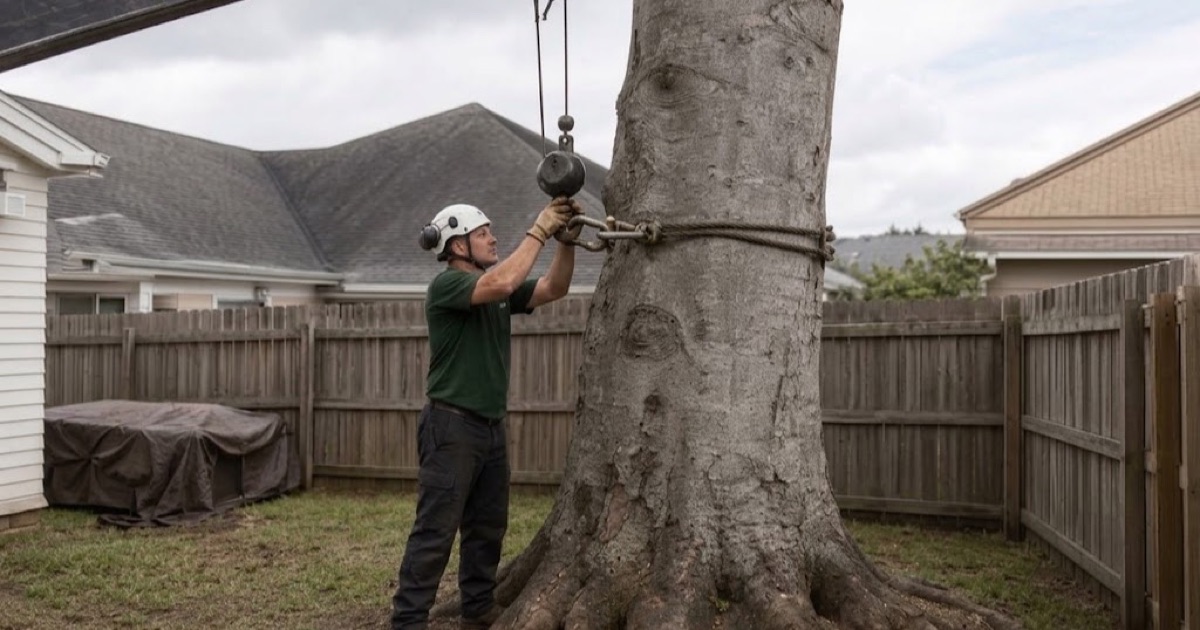
The classic case is a large tree whose canopy sits over a roof, a pool, a conservatory or a neighbor’s fence, with nowhere on the ground to put a piece once it is cut. Sectional rigging can handle a great deal of that, but every piece lowered through a tree loads the stem it is hanging from, and there is a point where the sums stop working. A crane takes each section vertically clear of everything before it is cut free, so nothing passes over the target at all.
Trees Nobody Should Be Climbing
Condition, not size, is the other trigger. A dead ash left brittle by emerald ash borer, a stem with advanced decay at the root collar, a union that has already cracked and moved, or a storm-damaged tree holding stored load are all trees that will not reliably support a climber or the forces of rigging. In those cases the crane is a safety decision rather than a productivity one, and it is not negotiable on price.
Where Access, Not Size, Decides It
Some jobs go to a crane because there is no route in for anything else. A courtyard, a steep drop behind a house, a garden reachable only through a neighbor’s property, or a tree hemmed in by hardscape can all rule out a lift and a tracked machine while leaving a clean overhead line from the street. Working out whether that geometry exists is done at the estimate, with the setup position and the reach checked rather than assumed.
How a Crane Removal Runs
Setup, Outriggers and Ground Protection
Most of a crane day is setup, and that is the part that protects the property. The machine needs level, load-bearing ground, and the outriggers concentrate very large loads onto small pads, so they go onto cribbing and mats sized for the surface. Positioning also has to avoid septic fields, drain lids, soft verges and buried services, which is why the ground gets looked at as carefully as the tree.
Picks, Load Charts and the Climber’s Part
Each piece is rigged, taken up onto the hook, cut free by a climber or a lift operator, then flown clear and lowered to a landing area for processing. Every pick is planned against the crane’s load chart for the weight at that radius, with the piece sized to the capacity rather than the capacity assumed to cover the piece. The climber’s job is far shorter than on a rigging removal, which is precisely why the method is chosen on a compromised tree.
Streets, Neighbors and Overhead Lines
A subdivision street with parked cars and a conductor running down one side is a real constraint on where a crane can stand. Approach distances to energized lines are set by the ANSI Z133 safety requirements and they apply to the machine as much as to a climber, so if the only workable setup is under a line, the utility that owns it becomes part of the plan. Neighbor access, closures and parking are arranged before the day rather than negotiated on it.
The Alternatives, and What We Recommend Instead
Spider Lifts and Tracked Access Machines
A spider lift tracks through a standard gate, sets up on outriggers in a back garden, and puts an operator into the canopy without loading the tree at all. On the tight post-1990 lots that make up most of this city it solves the same safety problem as a crane at a fraction of the cost and disruption. It does not lift material out, so it pairs with ground rigging rather than replacing a crane on a tree over a roof.
Rigging From the Tree Where That Is Safer
On a sound tree with usable ground beneath it, a climber with a rigging block, a bull rope and a friction lowering device remains the most efficient method there is, with every component matched to the working load limit for the pieces being moved. It needs a stem that can take the loads, which is exactly what the pre-work inspection establishes. Choosing this over a crane on a decayed tree to save money is how people get hurt.
Matching the Method to the Neighborhood
The practical rule across this service area is that the hub and the ring need different answers. New subdivision lots in Spring Hill and Thompson’s Station mostly need gate access and a tracked machine; the older streets in Columbia, Franklin, Brentwood, Oak Hill and Forest Hills hold the mature canopy where crane work is routinely the right call. We quote the method the tree needs rather than the machine we most want to send, and the estimate says which one and why.
- 20+ Years in Middle Tennessee
- Free Estimates
- Written Scope Before Work Starts