
Spring Hill Tree Removal has handled land clearing in Spring Hill, TN for more than twenty years, serving surrounding cities including Thompson’s Station, Columbia, Franklin, Brentwood and Nolensville. The work ranges from opening a fence line on a few acres to clearing a lot ahead of a build, and the two ends of that range need different machines, different permits and a very different conversation about what stays.
The part most contractors skip is the front end. Before anything is cut we establish what the city expects on that particular address, because in this ring the answer changes across the county line and sometimes across the street. Some cities want a land disturbance permit and a preconstruction meeting; some set a percentage of existing canopy that must survive; one suspends development approvals for three years if a lot is clearcut.
We also treat the trees that stay as part of the job. A tree that survives the clearing and then dies two seasons later because equipment ran over its root zone was not saved, it was just cut down slowly. Tree protection zones and fencing go in before machines arrive, not after somebody complains.
Clearing Methods and When Each One Fits
Forestry Mulching in a Single Pass
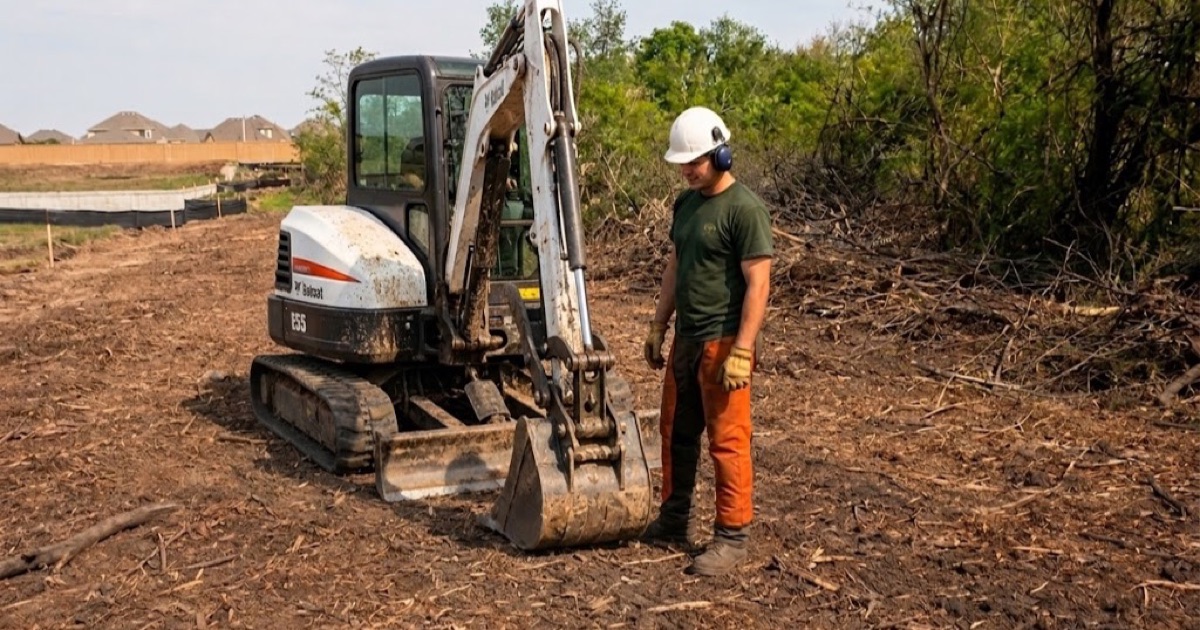
A forestry mulcher grinds standing brush and small stems to chip where they stand, leaving a mulch layer behind and nothing to haul. That makes it fast and comparatively cheap on pasture reclaim, fence lines, trail cutting and access lanes, and the mulch layer holds soil on a slope while ground cover re-establishes. Its limits are honest ones: it does not remove stumps, it does not produce a clean grade, and it struggles once stem diameter climbs past what the drum can take.
Selective Clearing and Deciding What Stays
Most lots are worth more selectively cleared than flattened. We walk the ground with the owner or the builder, mark the trees worth keeping on condition rather than on size alone, and clear around them, which usually means hand work and rigging near the keepers instead of a machine sweeping through. A mature white oak or shagbark hickory left standing in the right place is the one feature of a finished lot that cannot be bought later.
Full Clearing, Grubbing and Hauling
Where a building pad, a driveway or a utility corridor is going in, the ground has to come clean: stems down, stumps and root plates grubbed out, and the spoil loaded and hauled. This is where clearing stops being a tree job and becomes an earthmoving one, with tonnage leaving the site and a gate fee attached to it. We quote the haul against the county the material will actually go to rather than a round number.
Permits, Erosion Control and Where Material Goes
When Clearing Triggers a Land Disturbance Permit
Once work changes existing soil cover or vegetation on a regulated lot, most cities in this ring want a land disturbance permit before it starts, and several attach conditions that reach the contractor directly. Lewisburg requires the applicant to be the owner or an agent carrying written authority, and wants the contractor named on the application. Mount Pleasant requires a preconstruction meeting with its Planning and Zoning Director and a stormwater pollution prevention plan. Emergency work necessary to protect life or property is generally exempt, which is a narrow door rather than a general one.
Erosion and Sediment Control on Cleared Ground
Bare soil on a slope over clayey residuum sheds water rather than absorbing it, and the permit conditions in these cities exist because of what that does downstream. Controls follow the current state erosion and sediment control guidance: silt fence at the toe, stabilized construction entrances, and stabilization of exposed ground as work finishes rather than at the end of the project. Cities with water quality buffer setbacks around floodways, wet weather conveyances and sinkholes expect those distances honored, and they vary by city.
Burning, Mulching or Hauling the Material
The three exits for cleared material carry very different costs. Mulching in place is cheapest where the mulch can stay. Burning needs a Division of Forestry permit from October 15 through May 15 for open burning within 500 feet of forest, grassland or woodland, plus whatever the city adds. Hauling is priced by tonnage and by gate: the Maury County transfer station takes commercial loads at $78.00 per ton with a $25.00 minimum, while the Williamson County landfill takes brush, clean wood and chips at $40.00 per ton.
Tree Protection on a Construction Site
Tree Protection Zones and the Drip Line
The damage that kills a retained tree is almost always to the roots, and it happens through compaction, grade change and trenching rather than through the trunk. A tree protection zone is drawn to keep machines, spoil piles and material storage off the root zone, and it is measured from the drip line rather than from the trunk. Brentwood’s ordinance extends its required barrier to one and one-half times the radius of the drip line, which is a useful benchmark even where a city sets nothing.
Tree Protection Fencing, Installed Before the Permit
Fencing is a sequencing requirement, not a decoration. Brentwood specifies construction protection barriers of at least four feet in height, built of metal or wood to its own specification and installed before the permit is issued. Oak Hill requires orange plastic barrier fencing at the limits of the preservation areas, installed and maintained before construction begins, with the city’s review and approval required prior to the grading permit. Both mean the same thing in practice: the fence goes up before the first machine, or the approval does not come.
Retention Standards That Change at the City Line
How much canopy has to survive is a local decision and the spread across this ring is wide. Oak Hill requires a minimum of fifty-four percent of predevelopment tree canopy to be retained and specifically protects trees of eight inches diameter at breast height between a building and the street. Forest Hills prohibits clearcutting outright and suspends development approvals on a lot for three years where it happens, and it runs a two-year lookback on trees already removed. A clearing plan drawn for one of those cities is not valid in the next.
What Grows Back Here, and Clearing With a Purpose
Eastern Redcedar and Reclaimed Pasture
The regrowth being cleared on this ground is usually eastern redcedar, which colonizes thin residuum over limestone and takes over any pasture left unmown for a few seasons. That is why so much clearing here is cedar rather than hardwood, and it changes the method: dense small-diameter cedar mulches well and burns hot, while the same acreage of mixed hardwood does neither. Knowing what is standing before quoting is the difference between a fair price and a guess.
Fence Lines, Access Lanes and Sight Lines
The most common acreage job here is not a whole field but a strip: a fence line lost to cedar and brush, a lane back to a barn, a sight line at a drive entrance, or a firebreak. These are priced by the linear job rather than by acreage, they rarely need a permit, and they are usually mulched in place. Done on a cycle, a fence line stays a fence line instead of becoming a clearing project every decade.
Clearing Around Septic Fields, Wells and Utility Corridors
Clearing over a septic field, a wellhead or a buried service needs the locations established first and the machine kept off them. Public utilities get a Tennessee One Call notice; private laterals, field lines and irrigation do not, so what the owner knows is part of the plan. Where a corridor has to stay open long term, mulching on a cycle keeps it clear at a fraction of what re-clearing a mature stand costs later.
- 20+ Years in Middle Tennessee
- Free Estimates
- Written Scope Before Work Starts