
Spring Hill Tree Removal handles emergency tree removal in Spring Hill, TN, serving surrounding cities including Thompson’s Station, Columbia, Franklin, Brentwood and Nolensville, and has done so through more than twenty years of Middle Tennessee winters. Storm work is the part of this trade where the wrong decision is expensive in ways that have nothing to do with the price of the job.
We plan for what this area actually records rather than a generic severe-weather script. The load case here is ice: the January 2026 winter storm put half an inch or more of accretion across the Nashville metro and crippled it. The second case is straight-line wind on saturated ground, which fails trees at the roots rather than in the canopy because shallow residuum over limestone forces a wide flat root plate instead of deep anchorage.
What we will not do is work a canopy in conditions that make it unsafe, or touch a conductor that belongs to a utility. Three electric providers serve parts of this city and the drop at your address belongs to one of them, not to us. Saying that plainly on the phone at two in the morning is part of the service.
What Actually Fails Here, and How
Ice Loading and What Breaks First
Ice coats every twig and multiplies the weight a canopy carries until something gives, and it gives at the weakest geometry rather than the smallest diameter. Co-dominant stems with included bark open up, long horizontal laterals fold, and deadwood already hung in the crown comes out. That is why a pre-winter inspection reads unions rather than trunk size, and why the trees that failed in January 2026 were often the ones a homeowner considered healthy.
Straight-Line Wind and Windthrow
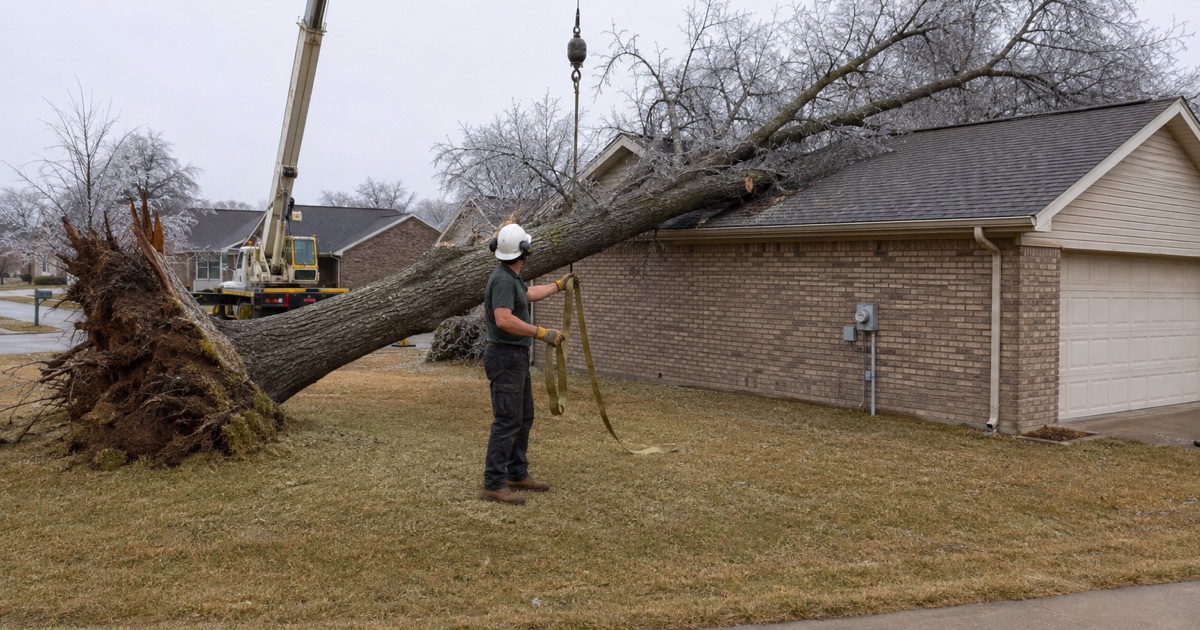
Wind produces a different failure. Instead of shedding limbs, the whole tree tips, taking a plate of roots and soil with it, because a tree that cannot root past the limestone spreads wide and shallow rather than deep. Once that plate lifts, the tree is a hinge rather than a column: it can settle further, roll, or drop back into the hole. We cut the stem free first and treat the upturned plate as a separate operation with its own machine.
Saturated Ground, and Why Timing Matters
The worst combination here is a mature crown, a long wet spell and wind arriving on top of it. Annual precipitation across the Outer Nashville Basin runs 48 to 54 inches, and the clayey residuum that covers much of this ground drains slowly, so the root zone stays wet longer than the surface suggests. Trees that stood through a dry summer gale come out of the ground in a modest wind three days into a wet week, which is why failure clusters rather than distributing evenly.
The First Hour, Before We Arrive
If the Tree Is on the House
Get everyone out of the rooms under and around the impact and stay out of them. Do not climb onto the roof to look, and do not pull anything with a truck or a chain — a stem resting on framing is loaded, and releasing that load in an uncontrolled way is how a partial roof failure becomes a full one. Photograph what you can see from a safe distance, because the adjuster will want the position of the tree before anything moves.
If a Conductor Is Involved
Treat every line as live and stay well clear, including anything lying in standing water. Call the utility that serves your address, which is settled by your electric bill rather than by your street: Middle Tennessee Electric, Columbia Power and Water Systems and Duck River Electric each serve parts of this city. No crew, ours included, works that tree until the utility has de-energized or cleared the conductor, and any contractor willing to start sooner is telling you something about how they work.
If the Tree Is Down and Nothing Was Hit
This is the common case and it is not an emergency, however alarming it looks. A stem lying in the yard is a scheduled removal and hauling job priced by tonnage and access, and paying an emergency rate for it wastes money. Keep people off it, keep vehicles off the root plate, and let us look at it in daylight with a proper quote attached.
Taking a Tree Off a Structure
Rigging Down Rather Than Pulling Off
A tree on a roof comes off in sections, from the top, on rope. A rigging block, a bull rope and a friction lowering device let each piece be taken under control and lowered clear, with the hardware chosen against its working load limit for the weight being moved, so the load leaves the roof deck gradually. Dragging the stem off in one piece is faster and it racks the framing further out of line on the way, which turns a repairable roof into a structural job.
Crane and Lift Work Over a Damaged Roof
Where the tree is large, the roof is already compromised or there is no safe anchor point in the canopy, the weight comes out overhead instead. A crane picks each section clear of the structure before it is cut free, and a spider lift puts a climber in position without loading the tree at all. Both need setup room and both are priced accordingly, so we tell you at the estimate whether the job is a rope job or a crane job rather than discovering it on the day.
Tarping, Photographs and the Written Scope
Before anything moves we photograph the position of the stem, the point of contact and the visible damage, and the written scope names what we removed, what we secured and what we did not touch. Securing an opening against weather is temporary work and is described as temporary. That paperwork is what lets a claim be assembled without a second visit to reconstruct what happened.
Insurance, Debris and the Week After
What a Homeowners Policy Actually Pays
Most policies pay to repair the covered structure the tree struck, cap debris removal separately at commonly around $500 per tree and $1,000 per incident, and pay nothing at all for a tree that comes down and hits nothing. Damage to the tree itself is capped again and frequently excludes wind. A tree on a vehicle is not a homeowners loss at all — comprehensive auto coverage is what responds. We itemize so the covered and uncovered parts of an invoice stay visible.
Storm Debris, City Programs and Contractor Haul
After a regional event, cities in this ring often run contracted debris collection from the public right of way for a limited window, and those programs are for homeowner-placed material. Spring Hill’s own sanitation policy is explicit that contractors dispose of their own debris and that its brush service takes homeowner-cut material less than 10 feet in length. So the haul is priced into our work rather than left at the curb, and on a privately platted street, where no city collection runs at all, it always was going to be.
Storm Chasers, Deposits and Written Quotes
A regional storm brings out-of-area crews into these neighborhoods within days, and Tennessee licenses no tree service, so there is no state credential to check them against. What protects a homeowner is ordinary paperwork: a written scope naming inclusions, a certificate of insurance, and no large deposit before work. We quote in writing, we do not canvass door to door, and we will give an honest waiting time rather than a same-day promise every crew in the region is making at once.
- 20+ Years in Middle Tennessee
- Free Estimates
- Written Scope Before Work Starts